Preparation
1. Prepare the puff pastry
Remove the cold puff pastry from the refrigerator.
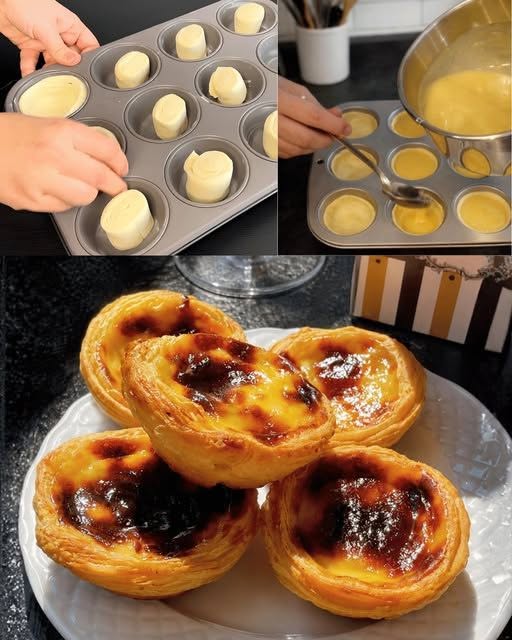
Roll it firmly on itself to obtain a compact cylinder.
Wrap it in cling film and then place it in the fridge for 15 to 20 minutes to firm up.
Then cut out sections about 2 to 3 cm thick.
Lightly butter a muffin tin or use Pastéis de Nata tins.
Place each piece of dough in the center of a cavity.
Using your slightly moistened thumbs, gently press the dough from the center to the edges as you work your way up the sides.
The bottom should remain quite thin while the edges will be slightly thicker in order to hold the cream well during cooking. Pastries
Place the pan back in the fridge while preparing the cream.
2. Prepare the cream
Pour the milk, liquid cream and lemon zest into a saucepan.
Heat gently until the first simmer without letting it boil.
Meanwhile, whisk the egg yolks with the sugar until the mixture is smooth.
Add the sifted flour and a pinch of salt.
Mix gently without incorporating too much air.
Gradually pour the hot mixture over the yolks while whisking constantly.
Then pour the mixture back into the saucepan.
Cook over low heat, stirring continuously until you get a smooth, shiny and slightly thick cream. Pastries
It should coat the spoon while remaining supple.
Remove the lemon zest if desired.
Let cool for a few minutes.
3. Garnish the tartlets
Remove the pastry bases from the refrigerator.
Fill them three-quarters full with cream.
Avoid overfilling the molds to allow the cream to rise slightly during cooking.
Gently smooth the surface.
4. Cooking
Preheat the oven to 240°C, ideally in static heat.
Place the tarts in the top of the oven. Pastries
Bake for 15 to 18 minutes.
The edges should be well flaky while the cream develops its famous dark brown spots that are almost burnt.
The center may remain slightly shaky: it will finish setting as it cools.
5. Resting
Let the Pastéis de Nata rest for about 10 minutes before removing them from the pan.
They are particularly tasty when eaten while still warm, when the dough is perfectly crispy.
