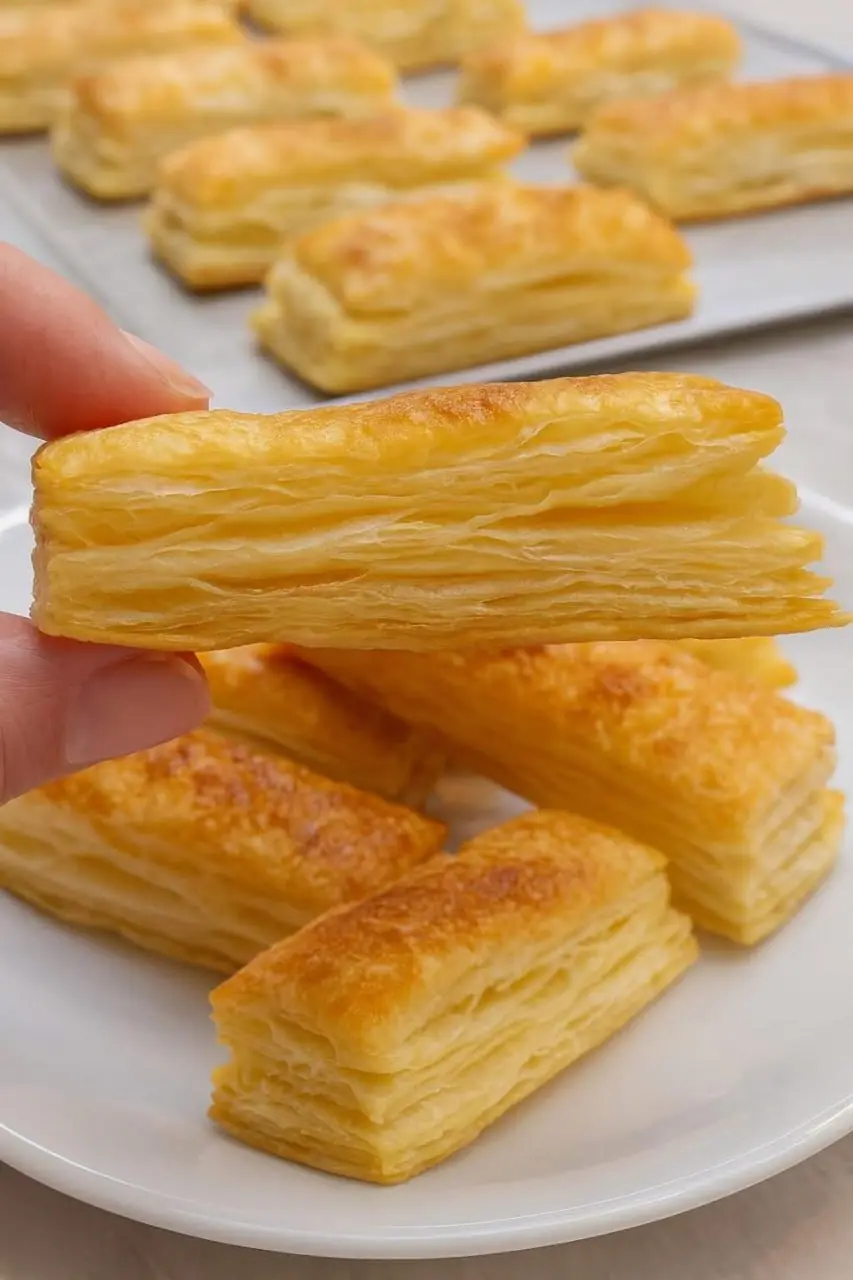
 History and Interesting Facts
Puff pastry has its origins in Arabic pastry making and was perfected in France during the Middle Ages. The technique of folding and stretching dough with butter became an art form that gave rise to iconic pastries such as croissants, palmiers, and tarts. The magic of puff pastry lies in the fact that it doesn’t contain yeast: its volume and layers come from the steam generated by the butter trapped between the folds during baking.
 Ingredients (for approximately 1 kg)
500 g strong white bread flour 
250 ml cold water 
1 tsp salt 
350 g cold butter (good quality) 
(Optional) a few drops of lemon juice 
 Step-by-step preparation
 Prepare the dough (detrempe)
Mix the flour, water, salt, and a few drops of lemon juice.
Knead only until combined (don’t overmix).
Form a ball, make a cross-shaped cut in the top, and let it rest in the refrigerator for 30 minutes.
 Prepare the butter
Flatten the cold butter between two sheets of parchment paper until it forms a flat rectangle.
Refrigerate until firm but pliable.
 First Fold
Roll out the dough into a cross shape.
Place the butter in the center and fold the ends over it.
Roll out into a rectangle.
 Fold and Refrigerate
Fold the dough into thirds (like a triptych).
Refrigerate for 20–30 minutes.
 Repeat Folds
Repeat this process 5–6 times, alternating the direction of rolling.
Between each fold, refrigerate to keep the butter cold.
 Ready to Use
After the final resting period, the dough is ready for tarts, pies, palmiers, or croissants.
 Nutritional Information (per 100g approx.)
Nutrient Amount
Calories 410 kcal
Protein 6 g
Fat 28 g
Carbohydrate 34 g
Sugars 1 g
Sodium 180 mg
 Health Benefits
