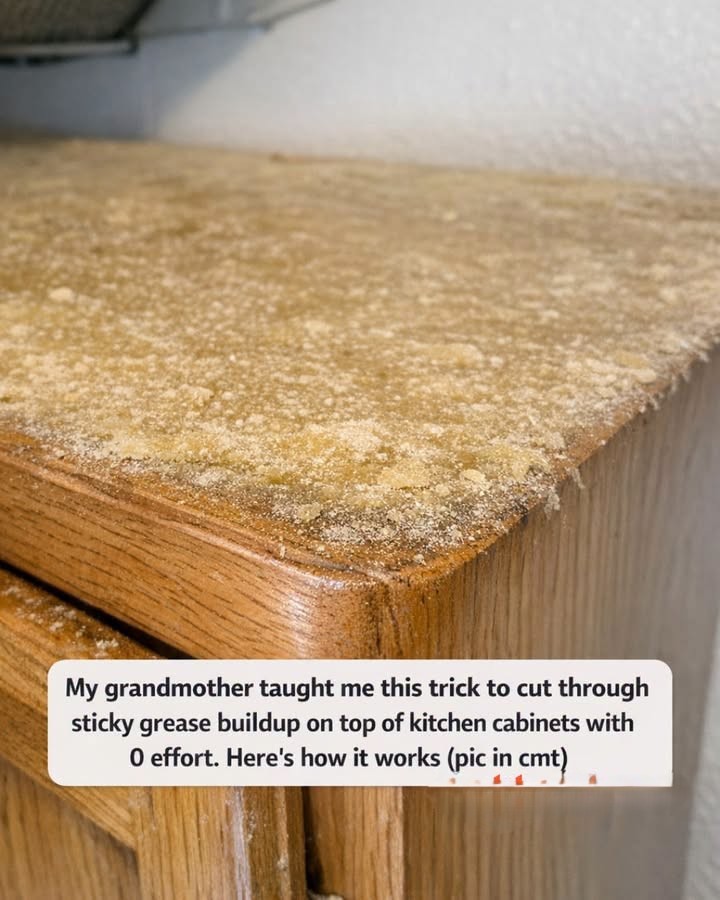
If you have upper kitchen cabinets that don’t quite reach the ceiling, you probably already know the unpleasant surprise waiting up there: a tacky, gray-brown layer of grease and dust that seems to glue itself to the surface. I learned how to deal with that mess from my grandmother, who never believed in wasting elbow grease when a simple kitchen trick would do the job better. After years of cooking everything from Sunday pot roast to weeknight stir-fries in my own Midwestern city kitchen, I can tell you she was absolutely right.
The beauty of this method is that it works mostly by softening and lifting the buildup before you scrub, which is why it feels like “0 effort” compared with the usual hard rubbing. In this article, I’ll walk you through exactly what causes that sticky film, the easy mixture my grandmother used, how to apply it safely, what tools make the job faster, and how to keep cabinet tops from getting so grimy again.
1. Why cabinet tops get so disgustingly sticky
The mess on top of kitchen cabinets is usually a combination of airborne cooking grease, dust, and sometimes a little moisture. Every time you fry bacon, sear chicken, sauté onions, or simmer a sauce, tiny droplets of oil rise into the air. They settle on high surfaces, especially above the stove line, and then dust sticks to that oily layer.
Over time, that turns into a paste-like coating that feels somewhere between syrup and glue. In kitchens without a strong vent hood, this can build up surprisingly fast. I’ve seen a noticeable film develop in 3 to 4 months in busy cooking kitchens, and a heavy layer accumulate over 12 to 18 months if no one ever wipes up there.
2. The grandmother trick: use heat and a grease-cutting layer first
My grandmother’s trick was simple: never attack hardened grease dry. Instead, lay a warm, grease-cutting solution over it and let time do the loosening. Her favorite was a mixture of very warm water, a few drops of dish soap, and a splash of white vinegar. The soap breaks down oils, the warmth softens the residue, and the vinegar helps cut through the dull, sticky film.
The “0 effort” part is the waiting. Rather than scrubbing right away, you let the solution sit on the grime for 5 to 10 minutes. That pause makes a dramatic difference. Instead of scraping off a glued-on layer, you’re wiping away softened residue.
3. The exact cleaning mixture I use
For a standard cleaning batch, I mix 2 cups of very warm water, 1 teaspoon of liquid dish soap, and 1 tablespoon of white vinegar in a bowl or spray bottle. You do not need a lot of soap. Too much can leave its own sticky residue, which defeats the purpose.
If the grease is especially heavy, I increase the dish soap to 2 teaspoons and keep the vinegar at 1 tablespoon. I avoid making the mixture stronger than that on finished wood, because too much vinegar or water can be harsh on some cabinet surfaces over time.
4. What tools make this job nearly effortless
You do not need specialty products. I usually gather a step stool, 2 microfiber cloths, a soft sponge, a small bowl of cleaning solution, dry paper towels or a dry cloth, and an old plastic spatula or plastic bench scraper. Microfiber is especially good here because it grabs greasy dust without just pushing it around.
If the cabinet top has a thick ridge of buildup, I also like using paper towels laid flat across the surface after I dampen them in the cleaning mixture. This creates a little “compress” effect, almost like a warm poultice for grease. It sounds old-fashioned, but it works beautifully.
5. Test one hidden spot first
Before you clean the whole area, test the solution on a small, out-of-sight corner. Let it sit for 2 minutes, then wipe dry. This is especially important if your cabinets are painted, stained wood, laminate, or have an older finish.
In my experience, diluted dish soap and a bit of vinegar are fine on most sealed surfaces, but I still don’t skip the test. Some finishes can dull if they stay wet too long, and older painted cabinets can soften if you oversaturate them.
