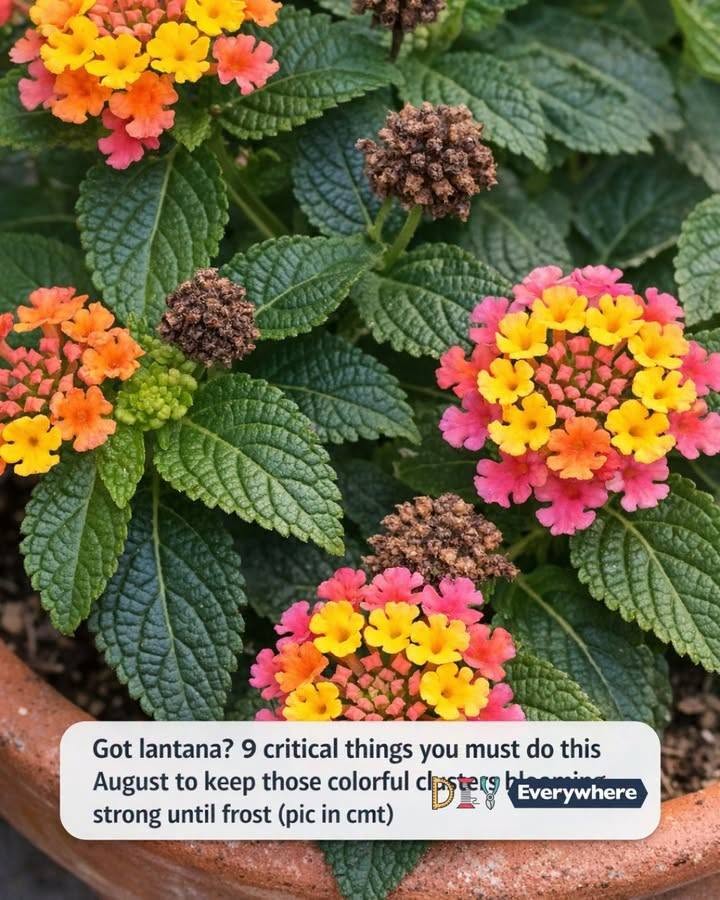
Every August, my lantana starts trying to teach me a lesson about summer gardening: if I coast, it slows down. Those bright little flower clusters can look absolutely unstoppable in June and July, then by late summer they begin to get leggy, dry out faster, and put more energy into seed than fresh blooms.
The good news is that a few very specific August jobs can keep lantana pumping out color right up to the first hard frost, even during the hottest, stickiest stretch of the season.
I grow lantana in pots by my front steps and in a sunny bed near the driveway, and over the years I’ve learned that August is not the month to “just let it ride.”
This is when I prune, feed lightly, reset my watering routine, and stay ahead of pests before the plant checks out for the season.
If you’ve got lantana and want those orange, yellow, pink, red, or lavender clusters to keep coming, here’s exactly what I’d do now.
1. Give your lantana a hard look before you do anything else
Before I grab pruners or fertilizer, I spend 5 to 10 minutes assessing each plant. I look for three things first: how many fresh blooms versus spent clusters I see, whether stems are stretching and getting sparse, and whether the leaves look healthy or stressed.
A good August check tells you what the plant actually needs instead of having you throw everything at it.
If your lantana is blooming mostly at the tips with bare stems underneath, it needs shaping. If the soil is bone dry 2 inches down and leaves are folding or crisping, watering is the priority.
If you see lots of green seedheads where flowers used to be, deadheading needs to move to the top of your list. And if the foliage is yellowing all over, especially in a container, the plant may need a light feeding or better drainage.
2. Deadhead spent flower clusters before they set seed
This is the single most effective thing I do in August. Once lantana starts putting energy into seed production, blooming often slows. I snip off faded flower heads just above a leaf node or side shoot using clean hand pruners, or I pinch them off with my fingers if the stems are soft enough.
I usually do a quick pass every 3 to 4 days on potted lantana and once a week in garden beds. If I skip a week during hot weather, I notice the difference.
The plant starts looking tired, and instead of producing fresh rounded clusters, it hangs onto browning heads and green berries. Removing those spent heads encourages the plant to redirect energy into new buds instead of seed.
If you’re short on time, prioritize the worst-looking clusters first. Even a 10-minute deadheading session can make a neglected plant look tidier and more vigorous almost immediately.
3. Trim back leggy stems by 4 to 6 inches
By August, lantana often gets stretched out, especially if it had a growth spurt earlier in summer or if it’s in a rich bed that pushed lots of stems.
I like to selectively cut back the longest, floppiest stems by about one-third, usually 4 to 6 inches, though a larger plant may handle 8 inches just fine.
The trick is not to shear the whole plant into a hard ball unless it is truly overgrown. I thin and shorten individual stems so the plant still has plenty of blooms while it resets.
That gives me a fuller shape and more branching, which usually means more flowers in 2 to 3 weeks.
When I do this on a Saturday morning, I almost always see fresh side growth by the following week if the plant is watered properly.
It feels a little scary to cut off flowering stems in peak season, but with lantana, a strategic trim in August pays off fast.
4. Water deeply, but stop the daily sprinkle routine
Lantana is drought tolerant once established, but “drought tolerant” does not mean “blooms best when constantly stressed.” In August heat, especially when temperatures sit in the upper 80s to mid-90s, I water deeply rather than giving a light splash every evening. Shallow watering encourages shallow roots and faster stress.
For in-ground lantana, I aim for about 1 inch of water per week minimum from rain or irrigation, and closer to 1.5 inches during prolonged heat waves.
That usually means one deep soak every 4 to 6 days in my heavier Midwestern soil, or every 3 to 4 days in sandy spots. I want the moisture to reach 6 to 8 inches deep.
Container lantana is a different story. In August, my porch pots sometimes need water once a day, and on extreme 95-degree days with sun reflecting off concrete, even twice.
I water until it runs out the drainage holes, then empty saucers so roots do not sit in water. If the top inch is dry and the pot feels noticeably lighter, it’s time.
