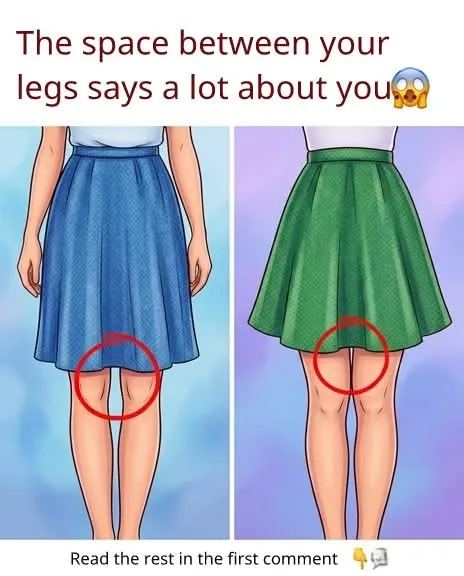
What the Space Between Your Legs Really Says About Your Body
The space between your legs can look different from person to person, and social media often makes people believe that the shape of this area reveals something important about their health, personality, attractiveness, or body type. In reality, the presence or absence of a “thigh gap” is usually a normal variation in human anatomy.
Some people naturally have a visible space between their thighs when standing, while others do not. Neither appearance is automatically healthier, fitter, or more attractive than the other. The shape of the legs is influenced by many factors, including bone structure, hip width, the angle of the thigh bones, muscle distribution, body-fat distribution, and genetics.
Understanding these differences can help replace unrealistic body expectations with a healthier understanding of normal anatomy.
What Is a Thigh Gap?
A thigh gap is the visible space between the inner thighs when a person stands with their legs relatively close together. For some people, the gap may extend from the upper thighs toward the knees. For others, the thighs may naturally touch while the lower legs remain separated.
The appearance can vary depending on posture and the position of the feet. Even a person whose thighs usually touch may create a temporary gap simply by changing their stance.
This is why comparing photographs can be misleading. Different poses, camera angles, clothing, lighting, and body positioning can make the legs appear dramatically different.
Why Do Some People Have a Thigh Gap?
One major factor is skeletal structure.
The pelvis and femur—the large bone in the thigh—determine much of the natural alignment of the legs. The angle at which the femurs extend from the hips can influence whether the knees and thighs naturally come closer together or remain farther apart.
Hip structure also varies considerably between individuals. Some people have a wider or differently shaped pelvis, while others have a narrower structure. These differences are normal and are not necessarily related to body weight.
Genetics can also influence the shape and distribution of muscle and fat around the hips and thighs. Two people with similar heights and weights can have very different leg shapes.
Does a Thigh Gap Mean Someone Is Thin?
Not necessarily.
Body weight can influence the amount of soft tissue around the thighs, but it is only one factor. A naturally occurring thigh gap can exist in people with different body sizes, and a person with a very slim body may not have one.
Trying to achieve a specific leg shape by aggressively restricting food or losing excessive weight can be harmful. The structure of the bones cannot be safely changed through dieting, and everyone has a natural body composition range.
A healthy body does not have to resemble a particular image found online.
What About the Knees and Lower Legs?
The position of the knees and lower legs can also vary because of natural alignment.
Some people have legs that appear relatively straight. Others naturally have a small inward or outward angle at the knees. Terms such as genu valgum and genu varum are used by healthcare professionals to describe certain types of leg alignment.
Mild differences in alignment can be completely normal. However, significant changes, pain, swelling, difficulty walking, or a noticeable difference that develops suddenly should be evaluated by a healthcare professional.
The shape shown in an illustration should therefore not be interpreted as a diagnosis.
Can Exercise Create a Thigh Gap?
Exercise can strengthen and reshape muscles, but it cannot completely control whether a person has a natural space between the thighs.
Exercises such as squats, lunges, step-ups, and other lower-body movements can strengthen the quadriceps, hamstrings, glutes, and other muscles. As muscle develops, the appearance of the legs may change.
However, exercise cannot safely reposition the bones of the pelvis or femurs to create a particular gap. Trying to force the body toward an anatomical shape it does not naturally have is not a healthy fitness goal.
A better goal is to build strength, mobility, balance, and endurance rather than chasing a particular measurement or visual feature.
Why Social Media Can Be Misleading
Images online frequently show carefully selected poses, lighting, clothing, camera angles, and editing. A person’s legs may look very different depending on whether the feet are together, turned outward, or positioned several inches apart.
Some images may also be digitally altered.
This can create the impression that there is one “correct” shape for women’s or men’s legs. There is not.
When people repeatedly compare themselves with highly curated photographs, normal anatomical differences can begin to feel like flaws. This can contribute to unhealthy dieting, excessive exercise, or negative feelings about one’s body.
Remember that a photograph captures one pose at one moment. It does not show the full complexity of someone’s health or anatomy.
Does the Space Between Your Legs Reveal Your Health?
A thigh gap by itself is not a reliable measure of health.
It cannot tell you whether someone has a healthy heart, good circulation, strong muscles, adequate nutrition, or an appropriate body composition. Likewise, thighs that touch do not automatically indicate poor health or being overweight.
Health is much more complicated than one visible body feature.
Important aspects of health include nutrition, physical activity, sleep, cardiovascular fitness, strength, mental well-being, medical history, and appropriate healthcare.
This is an important distinction because body-shape trends can sometimes turn ordinary anatomical characteristics into unrealistic health standards.
When Should Leg Shape Be Checked by a Doctor?
Most differences in leg shape are harmless. However, medical evaluation may be appropriate if a person develops new or worsening symptoms.
These can include persistent knee or hip pain, difficulty walking, repeated injuries, significant swelling, numbness, weakness, or a sudden change in the appearance of one leg.
Parents may also wish to discuss leg alignment with a pediatrician if a child’s legs appear significantly uneven, cause pain, interfere with movement, or change unexpectedly.
For adults, persistent pain or functional problems are more meaningful indicators that something deserves evaluation than whether a gap exists between the thighs.
Embracing Natural Body Differences
There is no single ideal leg shape.
Some people have a visible thigh gap. Some have thighs that touch. Some have a gap only when standing in a certain position. Others may have a gap around the knees or lower legs because of their natural alignment.
All of these patterns can occur in healthy people.
Instead of asking whether your legs look like someone else’s, it can be more useful to ask whether they are strong, comfortable, functional, and capable of supporting the activities you enjoy.
Your body does not need to satisfy an internet trend to be healthy.
Final Thoughts
The space between your legs does not reveal your personality, worth, attractiveness, or overall health. It is primarily influenced by anatomy, skeletal structure, muscle, fat distribution, genetics, and posture.
A thigh gap is neither a requirement for fitness nor proof of being healthier or thinner. Likewise, thighs that touch are not automatically a sign of excess weight or poor health.
If your legs are comfortable and function normally, there is usually no reason to worry about whether they match an image circulating online. Focus instead on nourishing your body, staying active in ways you enjoy, maintaining strength and mobility, and paying attention to genuine symptoms such as pain, swelling, weakness, or difficulty walking.
Most importantly, remember that normal bodies come in many shapes. The space—or lack of space—between your legs is simply one small feature of your anatomy, not a measurement of your value or your health.
